
INTRODUCTION
Urban exploration, or “urbex” as it is most often called, is more than just sneaking into abandoned buildings for the thrill of it. It is a symbolic and even existential process through which people engage with the fundamental narrative structure of the hero’s journey, which is not just a storytelling device but a profound pattern of transformation that maps onto the structure of human meaning.
CONFRONTING CHAOS
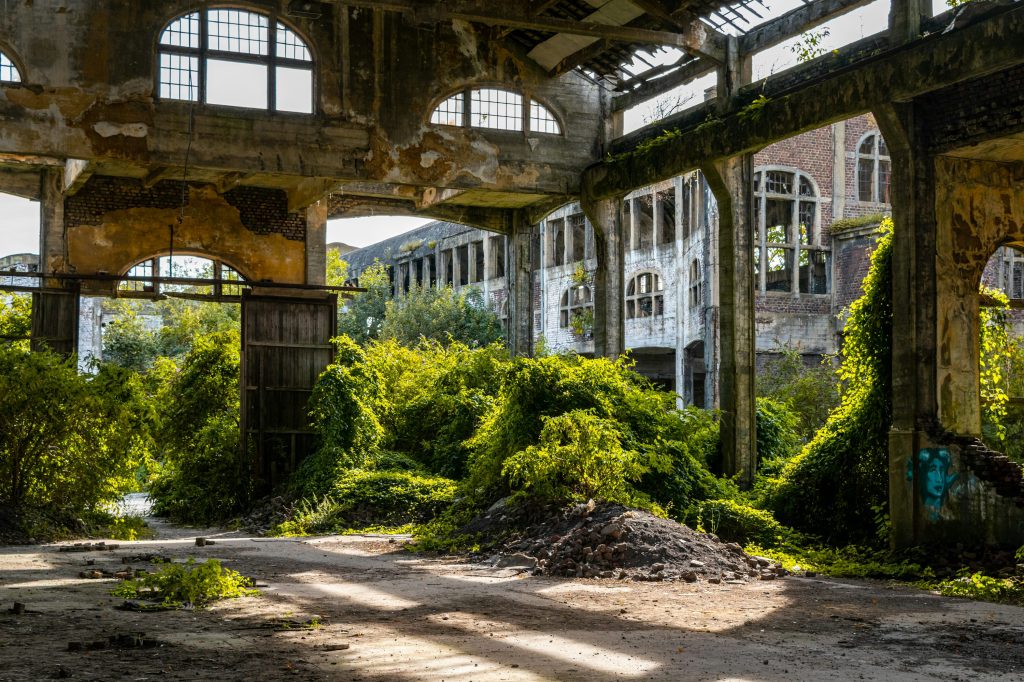
When someone sets out to explore an abandoned building, they literally step out of the known world (out of order) and into the unknown. That’s chaos, by definition. These buildings, which are essentially ruins, have fallen out of the domain of human sovereignty. No one maintains or cleans or watches them. It’s the voluntary crossing of a threshold into disorder.
And that’s exactly what the archetypal hero does. They leave the group representing civilization, safety, predictability, etc., and venture into the forest, the dragon’s den, or the underworld, because there is something to confront and a reward to retrieve there.
In urban exploration, you confront entropy itself as the total collapse of structure. Moldy ceilings, collapsed floors, shattered glass, peeling paint, rusted beams, etc. are not just aesthetic features of the building’s decay, but are symbolic representations of rot, mortality, and time itself. And to confront that with your eyes open in a courageous way isn’t inconsequential. If you face it properly, you can return changed by this experience. And what can you return with? Not gold, necessarily, but the treasure of photos, videos, stories, and, more importantly, a broadened perspective on the line between chaos and order. You’ve integrated a piece of chaos, and now you’re more whole.
SYMBOLIC RETRIEVAL AND PSYCHOLOGICAL INTEGRATION
When you explore abandoned places through urbex, you’re not just retrieving a memory or documenting the sight. You’re “rescuing” part of the forgotten past that, symbolically, can be understood as rescuing a fragment of your own psyche from unconsciousness.
Carl Jung, the founder of analytical psychology, discussed the need to integrate the shadow (being the disowned part of yourself). These abandoned places are physical manifestations of that shadow in some sense. They’re neglected zones of society that, when you voluntarily enter with awareness and reverence, allow you to symbolically act out this process of integration. You’re saying “I will go where no one else wants to go and see what no one else wants to see. I will venture into chaos and look where others avert their gaze.” And that’s the first step in any journey of psychological exploration.
“One does not become enlightened by imagining figures of light, but by making the darkness conscious.” – Carl Jung, Psychology and Alchemy (Collected Works Vol. 12, para. 120)
This is what constitutes the “redemptive” nature of entering an abandoned place and paying attention to what’s inside and what it means, especially when done with care for documentation and shared with others. You’re restoring a kind of dignity to that which has been discarded which, without sounding too dramatic, can be viewed as something like a sacred act if it’s done properly.
THE ABYSS STARES BACK
But the hero’s journey wouldn’t be heroic if there wasn’t a certain element of danger. And this isn’t optional, by the way: when you journey into the abyss of chaos, the abyss always stares back. These places are devoid of order and rules, and that includes the rules of morality, which is what constitutes a large part of the liminal and ambivalent nature of abandoned places. They’re thresholds at the border, sites of transformation or degeneration. You can enter them and see what they are, find what they offer, and emerge with new wisdom, or you can descend into that chaos.
And anyone who has been urbexing knows perfectly well what that means. Some people go into these places to deface them, destroy what little structure or order remains, to act out their resentment or own internal chaos. And not only that, these “allies of chaos” can lurk in the dark as squatters or scrappers, and often may represent a genuine risk to physical integrity or safety of an inattentive explorer. Drugs, theft, mindless destruction, and other forms of degeneracy are all failures of reverence. They’re refusals to take the place seriously, to see it as something real and meaningful and an opportunity for psychological growth. When people can’t tolerate the confrontation with chaos, they desecrate what they should approach with reverence.
And that speaks volumes to their own internal state. Because when you bring your attention to a place, you reveal who you really are beyond the level of your persona. You either elevate the environment you find yourself in or degrade it. There’s no neutrality in that regard. You’re helping tilt the place, and by extension yourself and the world at large, either upward towards heaven or downward towards hell. That’s the abyss looking back, in the form of testing your soul. What are you going to do?
CONCLUSION
These are just short comments on what I would like to be a much more in-depth exploration (no pun intended), but I think it is evident that urbexing can be seen as engaging with the hero’s journey. It can be redemptive. It can be transformative. But only if it is approached in the spirit of reverence, attention, and oriented upwards. Otherwise, you’re just another vandal in a dying world.
 NOETIC VIDEO
Leave a comment